Living on the Tweed Coast, a lot of the people I see spend their mornings in the water. Surfing and paddling are wonderful for body and mind — and like any activity you do often, they ask particular things of the body.
What paddling asks of you
Think about the paddling position: lying face down, chest lifted, neck extended to look ahead, arms working overhead in a repetitive cycle. Then add duck-diving, popping up, and twisting through turns. That's a lot of sustained extension through the neck and upper back, and a lot of repetitive load through the shoulders.
None of this is a problem in itself. Bodies are very good at adapting to what we ask of them. But adaptation is worth understanding, especially when it's paired with long hours at a desk or in the car during the week.
What people commonly mention
- Tightness between the shoulder blades after a long session
- A stiff neck, particularly looking up or turning to one side
- Shoulders that feel tired or tight with overhead movement
- Lower back stiffness after a lot of paddling or a long drive to a break
How I approach it in the studio
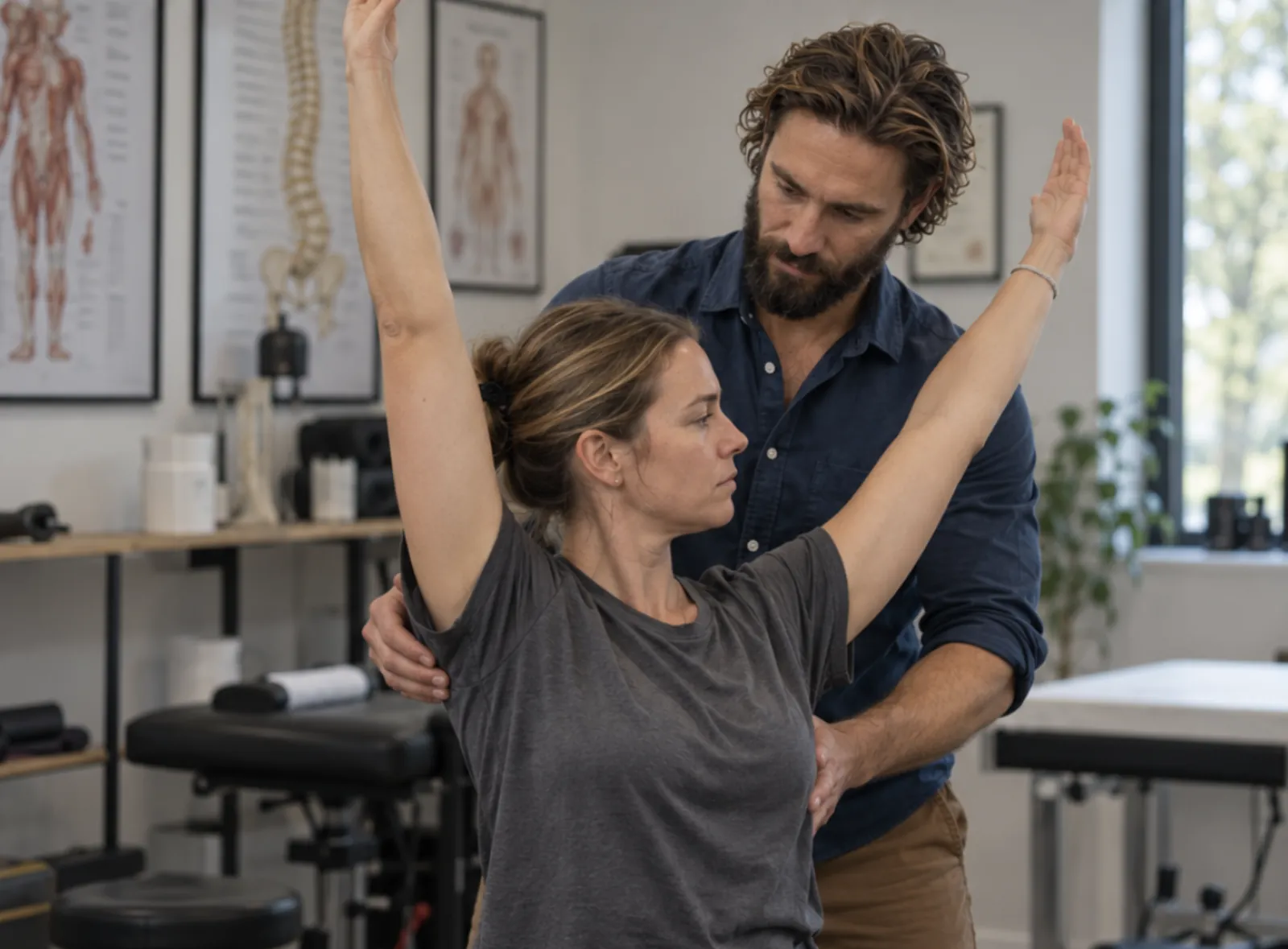
When a surfer or paddler comes in, I'm interested in the whole week, not just the waves. How many sessions? What does work look like? How do you sleep? Any old injuries from the water? Then I'll look at how the neck, mid-back, ribs and shoulders are moving, how the lower back and hips are sharing the load, and how posture looks when you're standing still.
From there, I'll explain what I've found and whether chiropractic care seems appropriate. If shoulder findings point towards a specific injury that needs imaging or a physiotherapist's input, I'll say so. Sometimes the most useful thing is simple: a few mobility ideas, or changes to how you warm up before you paddle out.
Spend a lot of time in the water?
Book an initial consultation at the Casuarina studio, a short walk from the beach.
A few things worth trying
These aren't a substitute for an individual assessment, but many people find them a sensible starting point: warm up your upper back and shoulders on the sand before you paddle out, vary your sessions where you can, and give your body some movement in other directions on non-surf days — rotation, gentle mobility and time out of the paddling position. And if something has been niggling for a while, it's worth getting it looked at rather than paddling through it.
If upper back tension sounds familiar, read more about shoulder and mid-back tension, or see how we approach care.
Dr Adam Williams is a chiropractor in practice since 2007 and founder of Restored Living Chiropractic in Casuarina, NSW. More about Adam
This article is general information only and not a substitute for individual assessment.